Start in the right place.
Direct Action is built as an operating flow. You do not need the whole system at once.
Start with the pressure, obstacle, decision, or execution risk in front of you. Then move deeper when you are ready to build the next capability.
Assess accurately.
Navigate obstacles rapidly.
Choose deliberately.
Execute with control.
Get the Starter SheetChoose the path that fits your situation.
Use this page to decide where to begin. Each path gives you a different entry point into the Direct Action operating flow, from a quick field prompt to structured training and deeper application.
I need to assess the situation more accurately.
Start with CSA Fast Track. Comprehensive Situation Assessment is the first Direct Action module because accurate assessment comes before obstacle navigation, move evaluation, and controlled execution.
I need a field prompt I can use today.
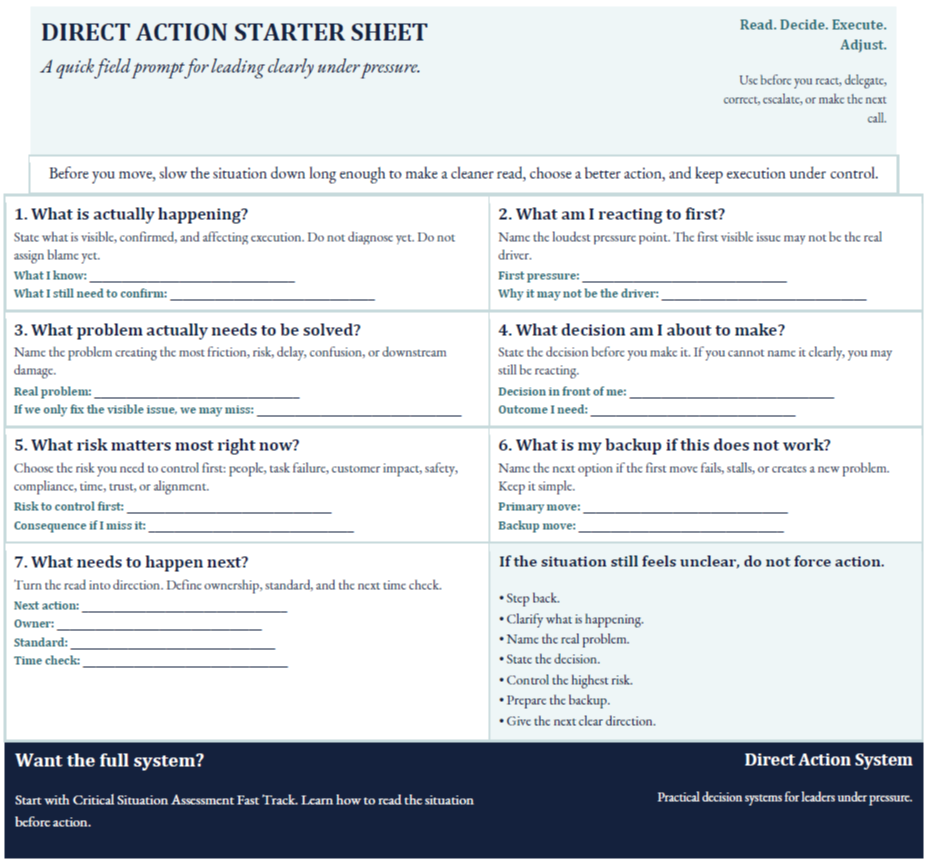
Start with the Direct Action Starter Sheet. It gives you a quick field prompt to assess what is happening, identify the pressure, locate the obstacle, and choose the next controlled move.

I want to learn more before I buy.
Start with the Direct Action Blog or Direct Action Briefings podcast. The free content helps you recognize the patterns that create wasted motion, unclear ownership, stalled decisions, missed obstacles, spreading risk, and execution drift.
Use the free content to understand the problem.
Use Fast Track when you are ready to build the capability.
Choose your listening platform:
Full Learning Pathway
Start with the first capability. Then build the rest in sequence.
Direct Action develops leaders to assess accurately, navigate obstacles rapidly, choose deliberately, and execute with control.
The full operating flow is:
CSA → DEPN → ACE → PRO → BRAIN + PACE → TMC → FLS → ALC
1. CSA
Read the situation before action.
Comprehensive Situation Assessment helps leaders understand what is actually happening before they react, correct, delegate, escalate, or commit resources.
2. DEPN
Navigate the obstacle.
Decision Execution and Problem Navigation helps leaders identify the obstacle, determine what kind of obstacle it is, and choose the correct engagement path before wasting effort.
3. ACE
Choose deliberately.
Analytical and Creative Evaluation helps leaders test the move before commitment. This is where they compare options, challenge assumptions, identify tradeoffs, and prevent the first obvious answer from becoming the automatic answer.
4. PRO
Control the risk.
Personal, Role, and Organizational Risk helps leaders understand what the move could cost the person, the role, the team, and the organization before damage spreads.
5. BRAIN + PACE
Build options before execution.
BRAIN helps leaders decide what information matters, compare benefits and risks, and sharpen the next move.
PACE helps leaders prepare primary, alternate, contingency, and emergency paths so execution does not collapse when conditions change.
6. TMC
Build options before failure.
Communicate and assign clearly.
Task Management and Communication helps leaders translate the move into direction, ownership, method, expectation, and accountability.
7. FLS
Turn intent into controlled action.
Field Leadership Sequence helps leaders receive intent, alert the team, build the plan, prepare the work, check conditions, communicate direction, adjust through execution, and recover cleanly for the next action.
8. ALC
Improve the next cycle.
Action Learning Cycle helps leaders capture what happened, identify what changed, improve the next move, and repeat the cycle with more control.
Fast Track or Deep Dive
Choose the depth you need.
Fast Track gets you started with the essential sequence.
Deep Dive turns disconnected advice into guided application through instruction, scenarios, worksheets, correction, and practice.
Do not rush the system.
You do not need to master every part of the Direct Action System at once.
Start with one capability. Use it under real pressure. See the value for yourself. Then move deeper when you are ready for more structure, more examples, and more application.
The point is not to collect more leadership advice.
The point is to build a repeatable way to assess accurately, navigate obstacles rapidly, choose deliberately, and execute with control when people are looking to you for direction.
Get the Direct Action Starter Sheet
Use it before the next decision, correction, handoff, escalation, obstacle, or recovery move.
It gives you six prompts to assess what is happening, identify the pressure, locate the obstacle, and choose the next controlled move.
After submitting, you will go directly to the download page.